


The relevance of the issue. The study of moral injury among the civilian population in the context of a full-scale invasion of Ukraine has reached a new level, as there is a need to clarify the social aspects of how it is experienced.
Presentation of the main material. Initially, the characteristics of moral injury (MI) were studied in active servicemen, veterans and combatants [1, 3, 5, 9, 10]. Subsequently, the focus shifted to investigating the manifestation of MT among representatives of various professions (medical staff, firefighters, police officers, social workers, etc.) [6, 7, 8]. The psychological characteristics of individuals experiencing moral injury are also being studied [2, 4, 5, 10]. However, the social context of this phenomenon remains overlooked – specifically, the ways in which moral injury is experienced by parents and their children. We therefore conducted an empirical study involving 420 young adults (aged 18–26) and their parents (guardians/caregivers). Based on the results of the «Moral Injury Symptom Scale (MISS-M-SM)» methodology, 298 pairs of young people and their parents were selected. The mean scores on the scales for the respective groups are shown in Fig. 1.
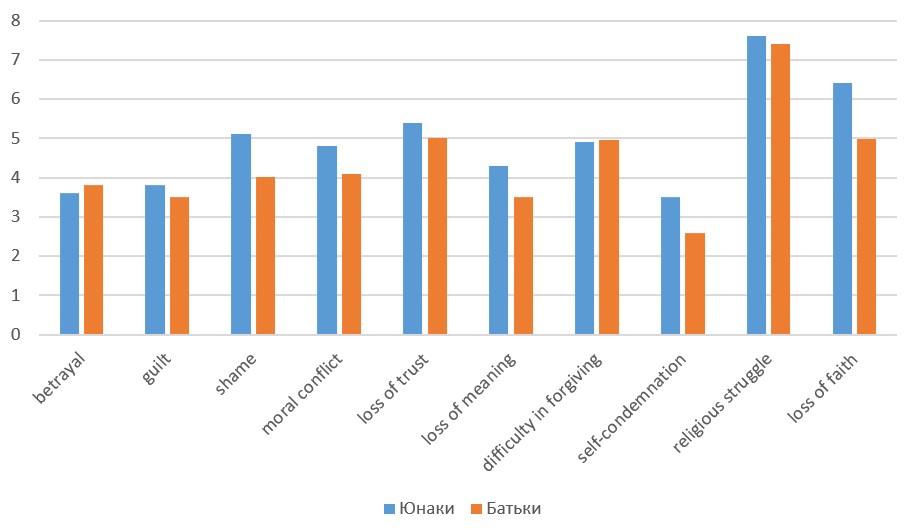
Fig. 1. Average scores for the severity of moral injury symptoms among early adolescents and their parents (guardians/caregivers) according to the «Psychological Trauma Symptom Scale (MISS-M-SM)»
Overall, it can be concluded that the severity of moral injury symptoms is slightly higher among adolescents than among their parents (with the exception of the «difficulty in forgiving» scale, where the results do not differ significantly). Statistically significant differences across the scales were identified for the following symptom scales: «shame» (F=31.69 at φ≤0.001), «moral conflict» (F=15.78; φ≤0.001), «loss of trust» (F=5.53; φ≤0.05), «loss of meaning» (F=27.38; φ≤0.001), «self-condemnation» (F=27.4; φ≤0.001), «loss of faith» (F=9.4; φ≤0.001) and «overall MT score» (F=41.89; φ≤0.001). Early adolescents also reported a sense that the experiences listed in the scales of the methodology were detrimental to their relationships in their studies (work) and other important areas of life (F=15.67; φ≤0.001).
We see the potential for further research into the issue of moral injury in early adolescence in exploring the relationship between how it is experienced within the child-parent dyad.
References
- Ames, , Erickson, Z., Geise, C., Tiwari, S., Sakhno, S., Sones, A. C., Tyrrell, C. G., Mackay, C., Steele, C. W., Van Hoof, T., Weinreich, H., & Koenig, H. G. (2021). Treatment of moral injury in U.S. veterans with PTSD using a structured chaplain intervention. Journal of Religion and Health, 60(5), 3052-3060. https://doi.org/10.1007/s10943-021-01312-8
- Boreiko Y., & Fedotova T. Covid-19 Pandemic as an Extreme Event: Effects, Reactions, Consequences. European Journal of Transformation Studies, 2021. 9(2), 125-142. Retrieved from https://czasopisma.bg.ug.edu.pl/index.php/journal-transformation/article/view/7092
- Drescher, K. D., Foy, D. W., Kelly, C., Leshner, A., Schutz, K., & Litz, B. (2011). An explanation of the viability and usefulness of the construct of moral injury in war Traumatology, 17(1), 8-13. https://doi.org/10.1177/1534765610395615
- Fedotova T., Kulchytska A., Boreiko Y., & Kykhtiuk O., Мudryk A. Psychology Of Moral Trauma, Aggression, And Coping Among Youth Experiencing Emo tional Distress During War, Youth Voice Journal, 2025. 15(4), 7-20, ISBN (ONLINE): 978-1-80463-076-1 https://doi.org/10.13140/RG.2.2.21106.98243
- Fleming, W. H. (2021) Moral Injury and the Absurd: The suffering of moral paradox. J. Relig Health.
- Nathaniel, A. K. (2006). Moral reckoning in nursing. West J. Nurs Res. 28(4), 419-38; discussion 439-48.
- O’Donnell, P., Farrar, A., BrintzenhofeSzoc, K., Conrad, A.P., Danis, M., Grady, C., etal.(2008). Predictors of ethical stress, moral action and job satisfaction in health care social workers. Soc. Work Health Care. 46(3), 29-51.
- Papazoglou, Konstantinos, Chopko, Brian (2017). The Role of Moral Suffering (Moral Distress and Moral Injury) in Police Compassion Fatigue and PTSD: An Unexplored Topic. J. Frontiers in Psychology. 8, https://www.frontiersin.org/articles/10.3389/fpsyg.2017.01999
- Shay, J. (2014). Moral injury. Psychoanalytic Psychology. Vol. 31(2), 182–191.
- Zasiekina, L., Kokun, O., Kozihora, M., Fedotova, T., Zhuravlova , O., & Bojko, M. (2022). A Concept Analysis of Moral Injury in Ukrainian National Guard Service Members’ Narratives: A Clinical Case Study. East European Journal of Psycholinguistics , 9(1), 296-314. https://doi.org/10.29038/eejpl.2022.9.1.zas

 inforum.in.ua@ukr.net